How to Wash Microfiber Towels (Without Ruining Them)
Quick Answer
To wash microfiber towels, sort them by contamination and by construction, then wash them alone — never with cotton — in warm water with a liquid microfiber detergent: 1–2 oz per normal load, 2–3 oz for wax or compound towels. Add an extra rinse, then tumble on low heat or hang dry. No fabric softener, no dryer sheets, no bleach, no powder.
You can tell a dead microfiber towel by how it behaves on glass: it pushes water around instead of pulling it in, and feels slick instead of grabby. Most people assume it wore out. It almost never did — something got into the fibers and stayed. Generic laundry advice was written for kitchen cloths, not for towels loaded with carnauba, spray sealant and compound grit.
Why Detailing Towels Die — and Why It’s Rarely Wear
A detailing microfiber is a polyester and polyamide blend, usually around 70/30, split in manufacturing into microscopic wedge-shaped filaments. Those wedges are the product: the channels between them hold water, and the sharp edges lift grit up into the nap instead of dragging it across your clear coat. Three things wreck that. Heat rounds the wedges off and the towel goes slick. Softener and dryer sheets deposit a lubricating film exactly where the water should go. Embedded wax and polish oil cools into the nap and stays there unless the wash is warm enough to move it. Wear is a distant fourth.
Pro Tip
Diagnose first. Drop water on a flat towel. A healthy one swallows it on contact; a contaminated one lets it bead and roll off. Beading means coated, not worn out.
Step One: Sort Before You Wash
Most people sort by how dirty a towel looks. Sort by two things instead: what is in it, and how it is built. Compound grit must never reach a plush towel headed for fresh paint — and neither must brake dust.
| Pile | What goes in it | How to wash it |
|---|---|---|
| 1. Glass & interior | Waffle glass towels, interior rags, screen and dash cloths | Lightest load, alone. Never with plush or twisted-loop towels — they shed into the flat weave and your glass towel lints. If a small rotation forces a combined load, only with other flat-weave or short-nap towels. |
| 2. Paint & quick detailer | Drying, waterless, QD and buffing towels, painted door jambs | Normal dose. Grows fastest; it sets your schedule. |
| 3. Wax & sealant | Wax removal, sealant buffing, coating maintenance | Heavy dose. Pre-soak if they sat first. |
| 4. Compound & polish | Anything used after a machine polisher | Own load, always. Pre-soak, then wash alone. |
| 5. Wheels, tires & engine bay | Anything used on wheels, tires, exhaust tips or the engine bay — including demoted towels | Own load, always. Never washed with piles 1–4; brake dust is embedded metal. |
Then sort by construction, which nobody writes about and every detailer does on instinct. A twisted-loop drying towel, a plush buffing towel, a flat waffle glass towel and a short-nap coating applicator don’t belong in one drum: the plush sheds into the flat weave and your glass towel lints. Pile 5 is the one that isn’t a preference — brake dust is embedded ferrous metal, so carry a wheel towel into the glass or paint pile and you’ve built yourself a scratch tool. Two more rules never bend: never with cotton, and never with a zipper, hook or Velcro. Our towel comparison covers which towel to buy, the drying towel guide covers twisted-loop, and you can restock from the microfiber collection.
Pile 2 fills fastest, because those towels touch the whole car. Two things slow it down: washing often enough that there’s less on the paint to begin with, and using chemistry that encapsulates grit rather than smearing it. One honest caveat while we’re here — a 3-in-1 waterless leaves a hydrophobic layer behind, and that same layer is part of why its towels belong in pile 2 and not pile 1.

Less grit in the towel
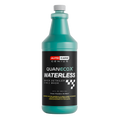
Quan EcoX Waterless Quick Detailer 3 in 1 Wash — $19.99
High-lubricity waterless wash that encapsulates grit so it lifts away instead of dragging. Cleaner chemistry means less road film and grit ending up in your towels in the first place.
Shop NowHow to Wash Microfiber Towels in a Washing Machine
Pro Tip
If your machine normally sees fabric softener, run one empty hot cycle with a cup of distilled white vinegar first, and wipe out the dispenser — that film lives in the drum. Check your machine’s manual before you do, though: a few HE manufacturers advise against running vinegar through their washers.
Water Temperature, Settled
Published guidance ranges from roughly 105°F to roughly 140°F depending on whose care label you read, and none of it explains why. Here’s why. Polyester and polyamide are thermoplastics, so enough heat softens a split fiber, rounds its tips and can partially fuse them — and that damage doesn’t come back. A glazed towel is finished. But wax and polish oils are temperature-dependent too, and cold water won’t release them, so cold-only advice kills detailing towels by contamination instead. Warm is the compromise; it’s what the Quan Wash directions call for, and your towel’s own care tag outranks any blog. The dryer is the real danger, because dry heat has no water carrying it off.
What Detergent to Use — and What Quietly Ruins Towels
| Option | Verdict | Why |
|---|---|---|
| Dedicated microfiber detergent (Quan Wash, CarPro MFX) | Use it | Formulated to release embedded wax and compound, then rinse out of the nap completely. |
| Free-and-clear liquid | Acceptable | No dyes or softeners. Weaker on wax loads. |
| Scented detergent | Avoid | Softening and fragrance agents deposit on fabric by design. |
| Powder | Avoid | Granules lodge in the nap and turn abrasive on paint. |
| Dish soap | Hand pre-soak only | Cuts oil, but over-suds a machine badly. |
| Softener or dryer sheets | Never | Their whole job is leaving a lubricating film. |
| Bleach | Never | Attacks the polyamide and weakens the fiber. |
| No detergent | Not enough | Water rinses dust. It won’t lift bonded wax. |

The house microfiber detergent
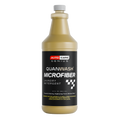
Quan Wash Microfiber Laundry Detergent — $21.99
Concentrated formula that lifts embedded wax, sealant and compound residue out of towels without clogging the fibers, then rinses completely clean.
Shop NowQuan Wash is our house answer, and the dosing is small: 1–2 oz for most loads, 2–3 oz for compound or wax removal, 1 oz per 5-gallon bucket to pre-soak. At that rate the 32 oz bottle covers roughly 16 to 32 loads, and the gallon roughly halves the cost per load. Two quieter offenders: oxi and scent boosters, built to leave residue behind, and hard water, which turns towels crunchy. And car wash shampoo isn’t towel detergent — shampoo is engineered to leave lubricity behind. See our soap guide.

For the car, not the towels
Quan Pink Car Soap Concentrated — $16.99
Hyper-concentrated pH-neutral shampoo with dense clinging foam that rinses clean for a spot-free, streak-free shine when dried properly. Mix 5 oz to 5 gallons — in the bucket, not the machine.
Shop NowHow to Wash Microfiber Towels by Hand (No Washing Machine)
Apartment, shared laundry, or you’d rather keep compound out of the family machine. Hand washing works, and for applicators and suede towels it’s arguably better.
Pro Tip
Wear nitrile gloves for bucket work. Quan Wash is a concentrated detergent — its label notes it may cause mild skin or eye irritation and may be harmful if swallowed or inhaled. Rinse skin with water on contact, keep it away from eyes, and store it out of reach of children and pets. And never mix it, or vinegar, with bleach or any chlorine cleaner.
This is the one place dish soap earns a role: a squirt in a hand pre-soak cuts oil on a wax-loaded towel. Keep it out of the machine, where it foams past what the drum can rinse.
How to Clean Microfiber Towels After Waxing, Polishing or Compounding
These get a dedicated load, every time. Wax and sealant towels are saturated with the exact material that clogs fibers, so they take the heavy dose and gain the most from a pre-soak. Compound and polish towels are worse: alongside the oils they carry abrasive particles and removed clear coat. Let that grit into your drying towel and the next wash is a scratch event. Our polisher guide covers the work that creates it.
How to Clean Microfiber Towels After a Ceramic Coating: Wash or Retire?
The advice online splits in half because nobody separates the two towels people mean. A leveling towel from a true coating install has resin curing in its nap within hours, and once that resin cures in the nap, no laundering we know of brings the towel back — the product is engineered to bond and stay put on paint, which is exactly why it won’t launder out of a fiber. Retire it, or demote it to wheels and the engine bay, where it washes with pile 5 only. A towel that buffed off a spray sealant or maintenance topper is different: lighter residue that launders out normally, provided you wash it soon instead of letting it cure in a hamper. The rule: if the product cures on paint, the towel is a consumable; if it wipes off, it washes. See our coating guide.
Drying: Low Heat, No Heat, or a Hanger
Air drying never costs you a towel — hang or lay flat, out of direct sun. If you tumble, use the lowest heat or air-fluff, and clean the lint trap first. No dryer sheets, and never iron microfiber. Either way, get them completely dry before storage: a damp towel folded into a bin is where the musty smell starts. Our 5-step weekend wash covers the drying step itself.
Troubleshooting: Why Your Towels Smell, Lint or Streak
| Symptom | Likely cause | Fix |
|---|---|---|
| Musty smell | Stored damp, or detergent left in the fibers | Strip wash, two rinses, then a vinegar rinse. |
| Lint on paint | Washed with cotton, or used straight from the bag | Wash new towels first; retire frayed edges. |
| Streaks on glass | Detergent, softener or dressing residue | Extra rinse; give glass towels a pile of their own and keep them there. |
| Rough, crunchy feel | Hard-water minerals | Half a cup of distilled white vinegar in the rinse. |
| Slick, won’t absorb | Softener film or embedded wax and polish | Strip wash. If it still beads, it’s done for paint. |
| Shedding or pilling | Dryer heat too high, washed with cotton, or a zipper, hook or Velcro in the load | Drop to low or no heat and re-sort the load. Heat damage doesn’t reverse. |
The Strip Wash: Reviving a Towel That Stopped Absorbing
A strip wash is just that: a solo, double-dose, double-rinse cycle — no additives, no heat. Be precise about the vinegar, too. It’s mildly acidic, so it dissolves hard-water minerals and carries off leftover detergent and odor. It does not touch wax, sealant or polish oil — that’s a warm-water-and-detergent job. Some pros publish a boiling method; we won’t write it up as a step, because boiling water and saturated towels is a scald risk.
Towels do finish. In our experience a well-cared-for detailing towel stays in paint-safe rotation for roughly a year or two depending on how hard you work it. When the edges fray or it still beads after a strip wash, demote it to wheels, jambs and the engine bay, and from then on it washes with pile 5 only, never again with a paint or glass towel. Then replace it — a towel you can’t trust on paint is the most expensive tool in the cabinet.

Where retired towels go to work
Quan Brown Acid-Free Tire & Wheel Cleaner — $14.99
Concentrated acid-free cleaner that dissolves brake dust, road grime and tire browning on most factory-painted, clear-coated and chrome wheels. Dilute 4:1, apply to cool wheels, dwell 30–60 seconds, rinse. Not for uncoated polished aluminum or anodized wheels.
Shop NowNew Towels, Storage and Keeping the Piles Apart
Wash new towels before first use. They arrive with loose fiber and manufacturing sizing, and the first pass over paint shouldn’t be the one that leaves lint. After that: fully dry, binned by category, color-coded so a glass towel never becomes a wheel towel. Piles merge back together on a busy Saturday, and one towel off the wrong shelf undoes the whole routine. Our beginner’s guide covers the rest.
Frequently Asked Questions
Can you use fabric softener on microfiber towels?
No — it’s the most common way good towels get ruined. Softener deposits a lubricating film, and on microfiber that film fills the channels that do the absorbing. Dryer sheets do the same thing.
Can you wash microfiber towels with regular detergent?
You can, but choose carefully. A free-and-clear liquid with no dyes, fragrance or softening additives is fine for light soil. Scented detergents deposit on fabric by design, and powders leave abrasive granules in the nap.
Can you wash microfiber towels with Dawn dish soap?
In a bucket, yes; in a machine, no. Dish soap cuts oil, which makes it a reasonable hand pre-soak for wax-loaded towels. In a drum it foams past what the machine can rinse.
Can you wash microfiber towels in hot water?
Warm rather than hot. Polyester and polyamide are thermoplastics, so enough heat rounds off the split fibers and costs you absorbency for good. But cold won’t release wax or polish oil either, so cold-only washing just trades heat damage for contamination.
How do you clean microfiber towels after waxing?
Give them their own load. Wax and sealant towels are loaded with the exact oils that clog fibers, so pre-soak them in warm water with 1 oz of microfiber detergent for up to an hour, then wash them alone on the heavy dose — 2–3 oz — with an extra rinse. Compound and polish towels get the same treatment plus one extra rule: they never share a load with a towel headed for paint.
Should you wash microfiber towels before first use?
Yes. New towels carry loose fiber and manufacturing sizing, and the first pass over paint is when you least want lint. One normal wash on a light dose is enough.
Why is my microfiber towel not absorbing water?
Almost always because it’s coated, not worn out. Softener film or embedded polish fills the channels that hold water. Run a strip wash — a solo, double-dose, double-rinse cycle — then repeat the water-drop test. If it still beads, retire it to the wheel pile and keep it there; it never goes back in with paint or glass towels.
Related Reading
- Microfiber Towel Brands Compared (2026) — which towel for which job
- Car Drying Towels: Twisted-Loop Picks, Tested
- Shop Microfiber Towels — replace the ones that are done
- Car Wash Soap 2026: pH-Neutral Shampoos Tested & Ranked
- Waterless vs Rinseless vs Traditional Car Wash: Which One, and When
- How to Apply a Ceramic Spray Coating Without Streaks
- Car Detailing for Beginners: The Complete Starter Guide
Wash Them Right, Replace Them Less Often
Quan Wash microfiber detergent — 32 oz or 1 gallon, shipped from our Orlando shop.
Shop Quan →