Waterless vs Rinseless vs Traditional Car Wash: Which One, and When
Quick Answer
Use a waterless wash for dust, pollen, and light road film when you have no water access; a rinseless wash for moderate film if you can fill a bucket; and a hose with two buckets for anything gritty. The rule is the dirt, not the convenience — waterless has no rinse, so grit you can feel gets dragged across your clear coat.
The Symplex Swap
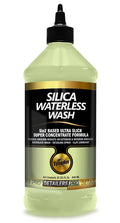
Right behind our Quan pick: Symplex Silica Waterless Wash, an SiO2 concentrate that doubles as clay lube and spray detailer.

Symplex Silica Waterless Wash from $17.18 · gallon $51.93 (about $0.41/oz)
SiO2 waterless wash concentrate that also works as a clay lube and spray detailer. Safe on paint, glass, plastic and metal.
Symplex manufactures in Orlando.
You can be competent with a wash mitt and still have nowhere to use one. An apartment lot with no spigot. An HOA that treats a driveway hose like a felony. Or the Florida version: pollen at nine, rain at three, and you are not hauling out two buckets. The question is which method this car needs today — and where saving water starts costing you clear coat.
What Waterless, Rinseless, and Traditional Washing Actually Are
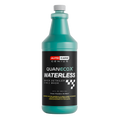
A waterless wash is a high-lubricity spray applied to a dry panel and wiped off with a towel — no bucket, no hose, no rinse. The chemistry does what a rinse normally does: it encapsulates the soil so the towel lifts it away instead of dragging it. Quan EcoX, our house version, cleans, shines, and leaves a hydrophobic layer in one pass.
A rinseless wash is a concentrate diluted into a bucket — commonly two to three gallons of solution for a whole car, though concentrates vary widely, so use the dilution the manufacturer prints on your bottle rather than a number off a blog. You wash out of that bucket and dry, with no rinse. Real solution floods the panel, so the dirt ceiling is higher than waterless. We do not make a Quan rinseless — the one on our shelf is Koch-Chemie Rapid Rinseless Wash, a 1L concentrate.
A traditional wash is the one everyone pictures: pre-rinse, two buckets with grit guards, pH-neutral shampoo, contact wash top-down, rinse, dry. Published water figures range widely — roughly 40 to 140 gallons depending on the source, your hose flow, and how long the water actually runs. It has the highest dirt ceiling, because it is the only method with a rinse step. The 5-step weekend wash covers the procedure; our shampoo guide covers the chemistry.
Waterless vs Rinseless vs Traditional: The Side-by-Side
One note before the numbers: the times and per-wash costs below are our own shop estimates on a mid-size car, not lab measurements. Panel count, soil level, and how heavy-handed you are with the trigger all move them.
| Factor | Waterless | Rinseless | Traditional (hose) |
|---|---|---|---|
| Water used | None | 2–3 gallons | Roughly 40–140 gallons |
| Dirt ceiling | Dust, pollen, light road film | Moderate film, light bugs, salt haze | Anything — grit, sand, mud |
| Time, mid-size car | 15–25 minutes | 25–40 minutes | 45–90 minutes with setup |
| Gear required | Spray bottle, 8–12 towels | Bucket, concentrate, mitt, drying towel | Hose, buckets, grit guards, mitt, shampoo |
| Scratch risk | Highest if you misjudge the dirt | Low to moderate; solution floats the soil | Lowest; the rinse removes grit |
| Where it works | Apartment lot, deck, open garage, roadside | Anywhere you can fill 3 gallons | Driveway or self-serve bay |
| Cost per wash | About $2.50–$3.75 (32 oz); $1.35–$2.00 (gallon) | Varies by brand and dilution | A couple of dollars of shampoo, plus water |
| Rinse step | None; the towel is the only removal | None; you dry off the panel | Yes — the safety margin |
The Dirt-Level Rule: How to Choose
Every article says to use waterless on a "lightly soiled" car and then refuses to define it. Here are the three soil tiers, with a test you can actually run — and grade the car on its worst panel, not its hood.
| Soil tier | What you are looking at | Method |
|---|---|---|
| Tier 1 — light | Dust, pollen, fingerprints, light spotting, a day or two of road film. Paint feels smooth. | Waterless |
| Tier 2 — moderate | A week of commuting, road film, light bug spatter, salt haze. Dull, not gritty. | Rinseless — Koch-Chemie Rapid Rinseless Wash |
| Tier 3 — heavy or gritty | Caked mud, sand, dried bug guts, salt crust, anything gritty to the touch. | Hose and two buckets |
Pro Tip
The two-finger test. Drag two dry fingertips along the lower rocker and the bottom six inches of the rear quarter — the dirtiest real estate on any car. Smooth and powdery is Tier 1. Grain or grit means abrasive material, and no chemical makes dragging that across clear coat a good idea. Frequent washing is what keeps a car in Tier 1: see how often you should wash and detail.
Is a Waterless Car Wash Safe for Paint? The Honest Answer
Honest version: it is safe on the right car and genuinely risky on the wrong one, and which car you have is almost entirely up to you. Any brand promising its spray will never scratch is overstating things.
In a traditional wash the pre-rinse removes loose material before anything touches the paint, and the final rinse flushes away what the mitt lifted. Waterless has no rinse at either end. The only things between a grain of grit and your clear coat are the product’s lubricity and the nap of the towel — and both have a finite capacity.
So you control two variables: how dirty the car is and how disciplined you are with towels. Tier 1 car, generous product, clean towel faces — and marring is very unlikely. Tier 3 car, three towels, a shy trigger finger — swirls a polisher has to remove later. Our own product directions say the quiet part out loud: for heavily soiled areas, pre-rinse with water if possible, or use multiple towels to avoid scratching.
How to Use a Waterless Wash Spray, Step by Step

The hero — 32 oz or 1 gallon
Quan EcoX Waterless Quick Detailer 3 in 1 Wash — $19.99
High-lubricity 3-in-1 waterless wash that cleans, shines, and leaves a hydrophobic layer in one pass. Encapsulates grit so it lifts away on the towel.
Shop NowPro Tip
Ventilate before you start. Quan EcoX may be harmful if swallowed or inhaled and can cause mild skin or eye irritation. Work outdoors or with the garage door open, avoid breathing the mist, and follow all label precautions. A full car atomizes four to six ounces of product into the air around you — that is not a sealed-garage job.
The Disadvantages of a Waterless Car Wash (and When Not to Use One)
The disadvantages of waterless car wash products all collapse into one: there is no rinse step to bail you out. That single missing step is what caps the dirt ceiling, what pushes eight to twelve towels and a laundry load through every wash, and what makes shade and a cool panel non-negotiable rather than nice to have. We would rather lose the sale than have you swirl a hood, so put the spray bottle down entirely if the car has caked mud, sand anywhere on it, gritty lower panels, dried bug guts, baked-on bird droppings, or salt crust. That is Tier 3, and Tier 3 needs a rinse — get the bucket out, and our best car wash soap guide ranks the field.

When the car fails the finger test
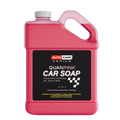
Quan Pink Car Soap Concentrated — $16.99
Hyper-concentrated, high-foaming, pH-neutral shampoo. Dense clinging suds lift dirt and grime, then rinse clean for a spot-free finish. About 5 oz per 5 gallons.
Shop NowTowels Are the Real Safety Variable, Not the Chemical
Here is why the towel count matters. In a bucket wash a dirty mitt gets rinsed and the grit falls out; in a waterless wash the grit has nowhere to go, so the towel is a storage device with finite capacity. Plush, high-GSM pile swallows particles below the contact surface, and which construction to buy for which job is a decision worth making once. A thin flat-weave has almost no reservoir, so whatever it picks up rides on the face into the next pass. That is the entire reason step two asks for eight to twelve towels instead of three.
A towel with visible dirt is out until laundered; one with a frayed edge is out permanently. And here is the part nobody connects — how you launder them decides whether they scratch next time, because softener film, detergent residue, and cotton lint all end up sitting on the one surface that touches your paint. We broke the whole routine down in how to wash microfiber towels without ruining them. The short version, straight off our own label: microfiber detergent only, no fabric softener and no bleach, then tumble on low heat or hang to dry. If you are heading toward rinseless, add the drying towel guide for the twisted-loop towel you will want.

The maintenance loop
Quan Wash Microfiber Laundry Detergent — $21.99
Lifts embedded wax, sealant, and compound residue out of the fibers without clogging them, and rinses clean so towels stay plush and safe on paint. Dose 1–2 oz per normal load, 2–3 oz for wax or compound towels, 1 oz per 5-gallon presoak.
Shop NowIs a Waterless Car Wash Safe for Ceramic Coatings?
Waterless washing as a method is fine on a coated car — better than fine, actually. A coating’s dirt-shedding behavior is what keeps the car sitting in Tier 1 instead of drifting toward Tier 3, which is exactly the band waterless is built for. The risk is mechanical rather than chemical: a dirty towel will mar a coating as visibly as it would mar bare clear coat. Check any individual product’s label for coating compatibility before you spray it, though — that is a per-product question, not a per-method one, and the answer is not the same for every bottle on the shelf.
If you have not applied one yet, our SiO2 spray sealant guide walks the whole job, and the Koch-Chemie wash and protection routine is our full maintenance schedule for a car that already has one. For the contact washes in between, our guide to soaps for ceramic-coated cars ranks the field.

For the contact washes in between
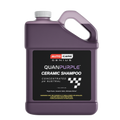
Quan Purple Ceramic Shampoo pH Neutral — $17.99
High-foaming, pH-balanced shampoo designed for coated vehicles and delicate finishes. Helps rejuvenate hydrophobic behavior and beading while lifting road film with less friction.
Shop NowHow to Wash a Car Without a Hose (Apartments, HOAs, and Water Restrictions)
Most people searching for waterless car wash products have an access problem, not a curiosity: no spigot in the apartment lot, a condo board that bans washing on the property, or a drought advisory. Washing a car without water is a real method in that situation, not a gimmick — it is the only option on the table, and it works for as long as frequent washing keeps the car in Tier 1.
The logistics are the part nobody covers, and they are most of the answer to how to wash your car in an apartment. Keep the bottle and a bin of clean towels in the trunk so the wash happens wherever the car is parked. Spray in open air rather than a closed parking garage, because the mist needs somewhere to go. Read the lease and the HOA rules before you assume you are breaking them — most rules that look like a washing ban are really a runoff and hose ban, which is the one thing this method does not produce. And plan the laundry, because a wash you cannot clean up after is a wash you will not repeat. Central Florida adds its own wrinkle: pollen season is textbook Tier 1, love bug season is the opposite because dried bug remains are bonded and abrasive, and the heat is why the directions call for shade and a cool panel.
What It Actually Costs Per Wash
Nobody publishes this number, so here is our estimate. Quan EcoX is $19.99 for 32 oz and $42.99 for the gallon, and in our experience a mid-size car takes roughly 4 to 6 oz per wash — more on an SUV. That works out to about five to eight washes from a 32 oz bottle, or roughly $2.50 to $3.75 each, and about 21 to 32 washes from the gallon, or roughly $1.35 to $2.00 each. The 4-to-6-oz figure is our shop’s working number rather than a measured test, so treat the range as a range. The caveat: a hose wash with concentrated shampoo is cheap too. Waterless wins on needing no facilities, not on chemical cost.
What Else a Waterless Wash Spray Can and Cannot Do
| Job | Verdict | Notes |
|---|---|---|
| Exterior glass | Yes | Light film only. Wipe one direction, then buff dry with a clean towel. Keep it off the windshield sweep area if your wipers chatter or judder on treated glass. |
| Interior glass | No | The oily haze on the inside of a windshield needs a dedicated glass cleaner. |
| Wheels | Light dust only | Bonded brake dust is Tier 3. And keep wheel towels completely separate — a towel that has touched a wheel never goes back on paint, because brake dust is embedded metal. |
| As a drying aid | Yes | Mist a rinsed panel lightly and the drying towel glides instead of grabbing. Our directions are written for a dry panel, so you are trading a little product concentration for less friction. |
| As clay lube | No — use a product labeled for it | Dedicated clay lubricants are formulated and diluted specifically for that job. CARPRO ECH2O, for instance, documents 1:200 as its clay-lube ratio, which tells you how much lubrication that job really wants. Under-lubricated clay is one of the most reliable ways to install marring. |
| On a wet car | Works, with a caveat | Surface water dilutes the product, so you give up lubricity in the exact place you need it most. |
| Interior surfaces | No | This is an exterior product. |
Pro Tip
Keep a 32 oz bottle and two folded towels in the trunk. Waterless washing works because of frequency — a car that gets a quick ten-minute maintenance pass every few days never leaves Tier 1, so it never needs the risky wash.
Frequently Asked Questions
Is waterless car wash safe for paint?
On a car that is only dusty or filmy, yes. Chemistry is not what hurts paint; friction is. Nearly every failure we see traces to one of two decisions — washing a car that was already past what the method can handle, or reusing a towel face that had something in it. Run the two-finger test first and the question answers itself.
How many towels do you actually need for a waterless wash?
Budget eight to twelve for a mid-size car: six to ten plush ones for wiping, plus two dry ones held back purely for buffing. Sedans sit near the bottom of that range, SUVs near the top, and dark paint always wants extra because it shows every fold you reused. Go below six and you start recycling dirty faces around the doors, which is exactly when risk spikes.
What is the difference between a rinseless wash and a waterless wash?
Waterless goes on dry: you mist the panel and lift the soil away on a towel, with no water at all. Rinseless is a concentrate you mix in a bucket, usually making up around two or three gallons of solution — ratios differ by brand, so follow your bottle. You clean straight from that bucket and dry the panel afterward, skipping the hose entirely. Rinseless handles more dirt; waterless needs no facilities.
What are the disadvantages of a waterless car wash?
A low ceiling on soil, first: light film only, never mud, sand, or bonded bugs. Then the towel bill, and the laundry that follows every single wash. It also demands shade and a cool surface, which rules out most of a Florida afternoon. And there is no safety net — misjudge the car and the mistake goes straight into the clear coat.
Can you use a waterless wash in winter or on a salted car?
Salt crust is Tier 3, so not as the main wash. Road salt is crystalline and abrasive, and dissolving it is a job for flowing water, not a towel. Take the car to a heated bay or a self-serve wand, flush the underbody and lower panels, then use waterless to keep it looking clean between real washes. Light salt haze with no grit you can feel is the exception, and that is rinseless territory.
Is a waterless wash cheaper than a car wash tunnel?
Usually, once you are past the first bottle: our own math puts a mid-size car at roughly $1.35 to $3.75 in product, against a typical tunnel ticket several times that. Two costs the sticker hides — your time, which a tunnel buys back, and towels, which are a real recurring expense if you launder them badly. The better argument is not price anyway: you control every point of contact, which is not true of a brush tunnel.
How do I wash my car in an apartment with no hose?
Waterless spray, in your parking space, with the bottle and towels already in the trunk. Work one panel at a time so nothing flashes dry, and stay out of direct sun even if that means moving the car first. Do the spraying outside rather than in an enclosed garage — you do not want to stand in the mist. Check your lease and your HOA rules too; many that sound like a blanket washing ban actually target runoff and hose use.
Can you wash your car during water restrictions?
Rules vary by county and utility, so check the current advisory where you live. In practice restrictions target hose use and runoff into storm drains rather than the act of cleaning a car, and a waterless wash produces neither. Commercial tunnels are often exempt as well, because they reclaim water. What you generally cannot do under an advisory is run a hose in a driveway.
Related Reading
- Best Car Wash Soap 2026: pH-Neutral Shampoos Tested & Ranked
- The 5-Step Weekend Wash That’ll Make Your Neighbors Jealous
- How to Wash Microfiber Towels (Without Ruining Them)
- How to Apply a Ceramic Spray Coating: SiO2 Step-by-Step
- Best Car Drying Towel: Twisted-Loop Picks, Tested
- Car Detailing for Beginners: The Complete Starter Guide
Wash Anywhere, No Hose Required
Quan EcoX 3-in-1 waterless wash — cleans, shines, and leaves a hydrophobic layer in one pass. Shipped from our Orlando shop.
Shop Quan →