Spot-Free Water for Detailing: DI vs RO, What It Costs, and Where to Get It in Kissimmee
Tap water carries minerals. When it dries on paint or glass, the water leaves and the minerals stay. Take the minerals out first, and there's little or nothing left to spot. Below: three ways to get it, what each costs per gallon, and where to fill up in Kissimmee.
Quick Answer
Spot-free water is water with its dissolved minerals removed or cut way down, usually by deionization (DI) or reverse osmosis (RO), so it leaves little or nothing behind when it dries. Detailers get it from a DI resin system on a hose, an RO system that fills a tank, or by the gallon from a supplier. Our Kissimmee store sells it for $0.35 a gallon at 2760 Michigan Ave Suite 4.
What Is Spot-Free Water?
A water spot is what's left when water evaporates. As Albuquerque's water utility puts it, "When water evaporates or is heated, dissolved minerals are left behind."
Everything dissolved in water is measured as total dissolved solids (TDS), in parts per million (ppm). Hardness is mostly calcium and magnesium, just part of the TDS. Even faucet water carries a real load of dissolved minerals, per USGS, and the EPA lists deposits and staining among the effects of high TDS. Spot-free water has most or all of that load stripped out. Pro+Aqua, which makes DI systems, puts the target here: "For a spot-free rinse, your TDS should be as close to 0 ppm as possible."
DI, RO, Softened or Distilled: Which Is Spot-Free?
| Water | What it is | Spot-free? |
|---|---|---|
| Tap | Carries dissolved minerals. OUC water in Orlando averages 129 ppm hardness | No |
| Softened | Calcium and magnesium traded for sodium (Penn State Extension) | No. CR Spotless says TDS out is about the same as TDS in |
| Reverse osmosis (RO) | A membrane holds back dissolved solids, and some feed water goes to waste (UNL Extension) | Reduced TDS. Check it with a meter |
| Deionized (DI) | Resin swaps mineral ions for hydrogen and hydroxide ions, which form water (CR Spotless) | Yes, while the meter reads 0. CR Spotless says it won't leave mineral deposits |
| Distilled | Water condensed from steam (USGS) | Low TDS. USGS counts it as pure water, though it can still hold some ions |
How Hard Is the Water in Orlando and Kissimmee?
Orlando's is hard. OUC says its water averages 129 ppm, or 7 grains per gallon, which USGS classes as hard (121 to 180 mg/L). Toho Water Authority, the Kissimmee-based water utility, doesn't list hardness in any of its five 2025 water quality reports, so we won't guess. For your own number, a handheld TDS meter on your spigot reads total dissolved solids, everything that can dry into a spot.
Pro+Aqua says hard-water areas and bright sun make spotting worse. More in our hard water and heat guide.
How to Get Spot-Free Water for Detailing
1. A DI (deionizer) system
Your hose water runs through canisters of ion-exchange resin. CR Spotless, a DI system maker, says the cation resin "replaces sodium, calcium, magnesium, and other cations with hydrogen ions (H+)," and anion resin swaps the rest for hydroxide ions. The two combine into water.
Resin gets used up, and water with more dissolved solids (higher TDS) uses it faster. Softened water doesn't help. The maker rates its DIC-20 at "around 300 gallons" with 220 ppm water, about 38 washes with a four-minute final rinse. Its own refill table runs $0.39 to $0.48 a gallon at that water quality. The biggest saver, per the maker: run DI on the final rinse only, not the whole wash.
2. A reverse osmosis (RO) system
RO pushes water through a membrane that holds back dissolved solids, per University of Nebraska Extension. Home systems add pre- and post-filters that need regular replacement, plus a storage tank.
Household RO units are slow, and they send water down the drain. Most recover 20 to 30 percent of the water fed in. At 20 percent, 100 gallons in gives you 20 gallons treated and 80 gallons of waste, and a home membrane makes 10 to 35 gallons a day.
CR Spotless also sells an RO+DI Pro System, from $1,999, rated at up to 300 gallons a day. It says the system makes spot-free water "for as little as $0.02 per gallon." It needs a power outlet and a drain for the RO waste.
3. Buy it by the gallon
No system, no resin to watch and no wastewater. You pay for what you use. That's what we sell in Kissimmee, at $0.35 a gallon.
| Option | Upfront | Per gallon | Upkeep |
|---|---|---|---|
| DI system (CR Spotless figures) | $344–$499 for its DIC, DIW and DI-120 units (base models, Oct. 2026 online prices; options cost more) | $0.39–$0.48 in resin refills at about 220 ppm. Higher-TDS water costs more | New resin when the meter reads above 0 ppm |
| RO system | Household units vary. CR Spotless Pro System from $1,999 | Most household units send 70–80% of feed water to waste. Pro System: as little as $0.02, per the maker | Filters need regular replacement |
| By the gallon at Auto Care Genius | No system to buy | $0.35 | None on your end |
At $0.35 a gallon, 50 gallons is $17.50 and 100 gallons is $35. That DIC-20 example of about 300 gallons for 38 washes works out to roughly 8 gallons per four-minute final rinse, or under $3 of water a car. Your flow and rinse time will change that.
Spot-Free Water Near Orlando: Our Kissimmee Store
Spot-free water is $0.35 a gallon at our Kissimmee store. Call or stop by for fill details.
| Spot-free water | Auto Care Genius, Kissimmee |
|---|---|
| Price | $0.35 a gallon |
| Address | 2760 Michigan Ave Suite 4, Kissimmee, FL 34744 |
| Phone | (844) 436-4870 |
| Store hours | Mon–Sat 8:30 AM–9 PM, Sun 10 AM–6 PM |
We serve all of Central Florida, including Orlando, St. Cloud, Celebration and Davenport. The store carries the full Auto Care Genius line, Quan included, so you can pick up Quan Pink or EcoX in the same stop, or order online and choose Local Pickup at checkout.
How to Use Spot-Free Water on a Detail
You don't need it for every step. Use it where it counts.
What You'll Need
- Spot-free water: from our Kissimmee store, or your own DI or RO system.
- A clean tank or jugs with tight lids, used only for water.
- A wash soap: Quan Pink or Symplex Silica Wash.
- A waterless or rinseless wash: Quan EcoX, Symplex Silica Waterless Wash or CarPro ECH2O.
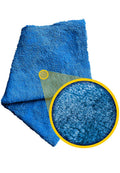
- Microfiber: Symplex Edgeless Ultra Plush for wiping and buffing, CarPro DHydrate for drying.
- A handheld TDS meter (optional).
The final rinse
Wash with whatever water you have, then make spot-free water the last water on the car.

Bucket Wash · 5 oz per 5 Gallons
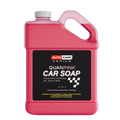
Quan Pink Car Soap Concentrated from $16.99
Hyper-concentrated dense-foam car soap. Its label says it breaks down dirt and grime without stripping wax and is safe for all exterior surfaces. SDS pH ~7. 32 oz, gallon and 5-gallon.
Shop NowWant SiO2 in the soap? Symplex says Silica Wash's water beading "reduces the risk of water spot formation."

SiO2 Soap · 3–4 oz per 5 Gallons
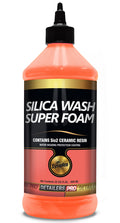
Symplex Silica Wash SiO2 Super Foam from $16.99
pH-neutral SiO2 wash for a foam cannon or bucket. Symplex says its water beading simplifies drying. Quart, gallon and 5-gallon pail.
Shop NowA spot-free final rinse, step by step
Pro Tip
Running your own DI unit? Check the meter before the first job. CR Spotless says to change the resin once it reads above 0 ppm.
Waterless and rinseless washes
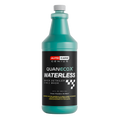
Quan EcoX skips the water question. Its label calls it a waterless wash that works "without a single drop of water," and its directions have no mixing step. For heavily soiled areas, it says to "pre-rinse with water if possible or use multiple towels to avoid scratching." Spot-free water on the truck is a good choice for that pre-rinse.

Waterless · No Mixing Step
Quan EcoX Waterless Quick Detailer 3-in-1 Wash from $19.99
High-lubricity waterless wash that cleans, shines and adds a layer of hydrophobic protection. Spray, wipe in one direction, buff with a second dry towel. SDS pH 7–8. 32 oz and gallon.
Shop NowMixing a concentrate is different, because the water goes on the paint. Symplex Silica Waterless Wash mixes 1:64 for a waterless wash, so about 98.5% of your spray bottle is water, minerals and all. Mix with spot-free water and the water adds little or nothing of its own.

Concentrate · 1:64 Waterless
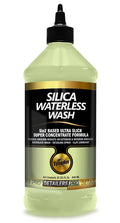
Symplex Silica Waterless Wash Concentrate from $17.18
Mix 1:64 for a waterless wash, 1:30 for clay lube or 1:96 as an SiO2 spray detailer. Symplex lists paint, clear coat, glass, plastic and metal. Made in Orlando.
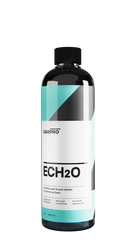
Shop NowSymplex doesn't name a water. CarPro does, in one recipe: its ECH2O "Magic Elixir" spray detailer calls for "400 ml of distilled water" in a 16 oz bottle. ECH2O also mixes as a rinseless wash at 0.7 to 1 oz per gallon. More in waterless vs rinseless vs traditional washing.
Glass and drying
Pro+Aqua says dissolved solids "can dry into chalky marks on paint and glass," and both DI makers list windows as a use, so you can give the glass a spot-free rinse too. Either way, keep a drying towel on the truck. The Las Vegas Valley Water District says "Mineral residue on surfaces only occurs when water is allowed to evaporate."
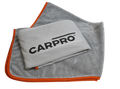
CarPro DHydrate is our drying pick at 540 GSM. It also comes in 20 x 22 in., and the DHydrate BOLD nearly doubles the GSM to 1000.

Drying Towel · 540 GSM
CarPro DHydrate Drying Towel, 28 x 40 in. $26.99
Dual-sided drying towel: a plush side for paint and a flat woven side for glass. 540 GSM.
Shop NowKeeping Spot-Free Water Clean in the Tank
Spot-free water stays spot-free only if nothing gets into it.
- Water only. CDC's water-storage guidance says never to use containers that held toxic chemicals like bleach or pesticides.
- Tight lid, out of direct sun. Both are on CDC's list.
- Opaque, not clear. Texas A&M AgriLife says a clear tank lets sunlight in and raises the chance of algae growth.
- Clean hose and nozzle. Don't dip anything dirty into the tank.
- Fill for the jobs ahead, not for months of storage.
- Rinse well after cleaning the tank, so nothing left behind ends up in the next load.
Feeding a pressure washer from the tank? Not every machine can. Kärcher says its SH 3 suction hose is "Compatible with Kärcher K4 and K5 pressure washers ONLY." Check your manual and filter the inlet. More in our pressure washer guide.
Safety note: follow every label, keep products away from children and don't ingest them. Quan EcoX and Quan Pink say to avoid contact with eyes and skin. EcoX adds: avoid breathing mist and ensure adequate ventilation, and work in shade on a cool surface. Symplex Silica Waterless Wash also calls for a cool surface. CarPro says to test ECH2O and Spotless 2.0 in an inconspicuous spot first. Spotless 2.0 is acidic (pH 4): use it in a well-ventilated area and don't inhale it, keep it out of sun and off hot surfaces, don't spray it directly on glass, wear chemical-resistant gloves and eye protection, and wash afterward to neutralize it. CarPro says it may affect window coatings and traditional sealants and waxes.
Frequently Asked Questions
How do you get spot-free water for detailing?
Run your hose through a DI resin system, make it with an RO system that fills a tank, or buy it by the gallon. In Central Florida, Auto Care Genius sells spot-free water for $0.35 a gallon at 2760 Michigan Ave Suite 4, Kissimmee. Call (844) 436-4870 for fill details.
What type of water is best for car detailing?
Water with as little dissolved in it as possible: DI, RO or distilled. For a spot-free rinse, Pro+Aqua says to aim for TDS as close to 0 ppm as possible. You can wash with tap water if you dry the car before the water evaporates.
What do detailers use for water?
Detailers use tap water from a hose and a fast dry, water from their own DI or RO system, or spot-free water bought by the gallon and hauled in a tank. Spot-free water is worth using for the final rinse, for mixing rinseless or waterless concentrates and on glass. Waterless washes like Quan EcoX are made to work without water.
Can detailers remove water spots?
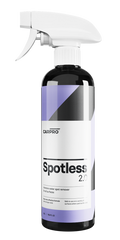
Yes, when they're mineral deposits sitting on the surface. An acidic remover like CarPro Spotless 2.0 (pH 4) "chemically breaks down the mineral deposits left behind by water droplets." If a spot has etched into the finish, CarPro says to polish it. See our water spot remover guide.
Is soft water the same as spot-free water?
No. Penn State Extension explains that a softener trades calcium and magnesium for sodium, and CR Spotless says the TDS coming out of a softener is about the same as what went in.
Do I need to dry the car after a spot-free rinse?
Follow your soap's label. Quan Pink's ends with a towel dry, and Symplex Silica Wash's with a microfiber towel or air blower. CR Spotless says DI water won't leave mineral deposits, so a DI rinse takes the pressure off while you dry.
Where can I get spot-free water near Orlando?
Auto Care Genius, 2760 Michigan Ave Suite 4, Kissimmee, FL 34744, sells spot-free water for $0.35 a gallon. Call (844) 436-4870 or stop by for fill details. Store hours are Mon–Sat 8:30 AM–9 PM, Sun 10 AM–6 PM.
Related Reading
- How to Wash a Car With Hard Water in Desert Heat (Southwest City Guide)
- Best Water Spot Remover for Cars: Paint, Glass and Etched Spots
- Waterless vs Rinseless vs Traditional Car Wash: Which One, and When
- Best Car Drying Towel (2026): How to Choose One and Avoid Drying Scratches
- Best Pressure Washer for Car Detailing (2026): Why GPM Beats PSI
Fill Up in Kissimmee
Spot-free water is $0.35 a gallon at 2760 Michigan Ave Suite 4. Call (844) 436-4870 for fill details, and pick up Quan Pink or Quan EcoX in the same stop.
Get Store Details →