Symplex Compound Guide: Turbo X1 vs Piranha X1 vs Nitro X1
Quick Answer
Symplex numbers its X1 body shop compounds by how hard they cut. Turbo X1 is Cut 7 for medium sanding scratches, Piranha X1 is Cut 8 and is the one Symplex calls its true one-step, and Nitro X1 is Cut 9 for moderate to heavy sanding marks. Pick the lowest number that still clears your worst defect in one pass — going harder than you need just buys you a longer refining stage afterwards. All three are optimized for rotary polishers.
The number is the spec, not the name
Most compound ranges make you guess. One bottle says heavy, the next says ultra, and neither tells you whether it'll clear 1500-grit sanding marks. Symplex skips that. Every X1 compound carries a cutting-power number out of 10: Turbo X1 is Cut 7, Piranha X1 is Cut 8, Nitro X1 is Cut 9. Higher number, harder cut.
That makes the buying decision simple in a way it usually isn't. You're not comparing marketing words. You're picking a point on a scale.
All three run the same underlying chemistry — Symplex's Ultimate Premium Abrasives in a diminishing abrasive system. The abrasives break down as you work, so the compound starts by cutting and ends by refining. That's why Symplex calls these one-step products: the finish at the end of the pass is meant to be good enough to move on from.
Symplex compound comparison at a glance
| Compound | Cut | What it clears | Pad | Pint price |
|---|---|---|---|---|
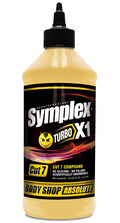
| Turbo X1 | 7 | Medium sanding scratches | Foam; wool or microfiber for faster cut | $16.98 |
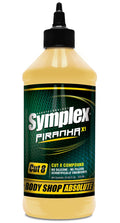
| Piranha X1 | 8 | Medium to moderate sanding scratches | Wool or microfiber; foam for final gloss | $20.08 |
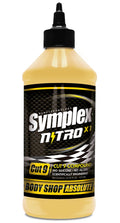
| Nitro X1 | 9 | Moderate to heavy sanding scratches | Wool, microfiber or foam cutting pad | $23.54 |
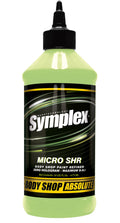
| Micro SHR | Refine | Holograms, buffer trails, compounding haze | Foam finishing | $18.63 |
Symplex says all three compounds are trim-safe, with very low dust and no splatter, and they come in pint, quart and gallon.
Turbo X1 — Cut 7, the medium one-step
Turbo X1 is the entry point, and for a lot of work it's also the finish line. It removes medium sanding scratches and finishes down to a very high gloss as the abrasives break down, and Symplex says it's often used as a one-step.
If your worst defects are medium sanding scratches or lighter, start here. It's the cheapest of the three, and the one that leaves the least refining work behind it.

Cut 7 · Medium
Symplex Turbo X1 Cut 7 Body Shop Compound — $16.98
Medium-cut compound for medium sanding scratches that finishes down to a very high gloss. Optimized for rotary; foam pad, or wool or microfiber for faster cut.
Shop NowPiranha X1 — Cut 8, the true one-step
Cut 8 is a real step up in aggression from Turbo, and it's the one Symplex positions as its true one-step corrector. It removes medium to moderate sanding scratches and finishes down to a high gloss, so on most colors you can skip a dedicated polishing stage.
That phrase — on most colors — is doing real work. Soft, dark paint shows everything. On black you'll likely still want the refiner. On a light metallic, Cut 8 on its own often finishes clean.

Cut 8 · True one-step
Symplex Piranha X1 Cut 8 Body Shop Compound — $20.08
Symplex's true one-step compound. Corrects and finishes in one pass, with very low dust, no splatter and no staining on trim.
Shop NowPro Tip
If you're only buying one Symplex compound, buy this one. Cut 8 covers the widest band of real-world defects, and it's easier to slow a compound down with a softer pad than to make a medium cut do work it can't.
Nitro X1 — Cut 9, for the jobs Cut 8 won't clear fast enough
Nitro X1 is a high-cut compound for moderate to heavy sanding scratches. Symplex says it can also finish down on its own when paired with a foam pad. This is the bottle for a panel that's been sanded, not a car that's been washed badly.
Pads: Symplex lists a wool, microfiber or foam cutting pad for Nitro. Wool or microfiber gives the most cut, and a foam pad is how it finishes down as a stand-alone.

Cut 9 · High cut
Symplex Nitro X1 Cut 9 Body Shop Compound — $23.54
High-cut compound for moderate to heavy sanding scratches. Body shop safe, with no silicone or fillers. Optimized for rotary; wool, microfiber or foam cutting pad.
Shop NowMicro SHR: the step that makes the cut look finished
Aggressive compounding leaves holograms, buffer trails and micro-haze behind. Under shop lights you might not see them. Under the sun in a customer's driveway, you will.
Micro SHR is the refining stage — precision-milled diminishing micro-abrasives on a foam finishing pad, run on a rotary or a DA. It clears what the compound left and takes the panel to a swirl-free gloss. On dark and soft paints, where holograms show worst, treat it as mandatory rather than optional.

Refining step
Symplex Micro SHR Body Shop Paint Refiner — $18.63
Removes holograms, buffer trails and compounding haze after heavy cutting. Soft foam finishing pad, rotary or DA. No silicones, waxes or fillers.
Shop NowLook See Control: the step that tells you if you're done
Here's the trap that catches a lot of corrections. Polishing oils fill what you didn't remove. The panel looks perfect in the bay, the customer parks in the sun three days later, and the marring is back — because it never left.
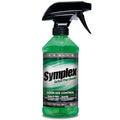
Look See Control is an alcohol-based panel wipe that strips those oils so you inspect the real surface. It's ready to use, pH 7.6, and Symplex also lists it as the surface prep before ceramic coatings, PPF and sealants. Mist it onto the panel or a clean microfiber, wipe gently, and flip the towel often.

Inspection · Coating prep
Symplex Look See Control Prep 16oz — $14.99
Alcohol-based panel wipe that strips polishing oils so you see the true correction state. Also the prep step before a coating.
Shop NowPro Tip
Wipe the panel before you decide you're finished, not after. Two minutes with a panel wipe is cheaper than a comeback.
When throughput matters more than the last 5% of gloss
The X1 range is built around finish quality per pass. The Rhino Production pair is built around panels per hour. Rhino Production Rubbing Compound is quick-cutting and fast-acting, and Rhino Production Machine Glaze clears the swirls and machine marks that fast work leaves behind.
They come in quart and gallon only, which tells you who they're for. If you're measuring work in hours per panel, stay on the X1 ladder. If you're measuring it in panels per hour, this is the pair.
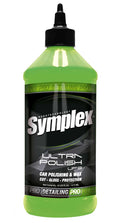
There's also Ultra Polish UP3, which is a different idea again: it corrects moderate defects like swirls, scratches and water spots and leaves polymer and wax protection behind in the same pass. For lot work or a volume detail where a full correct-then-protect cycle isn't billable, it collapses two stages into one.

Correct + protect
Symplex Ultra Polish UP3 Polish & Wax — $16.68
One-step polish and wax that removes moderate defects and leaves polymer and wax protection in the same pass. Trim-safe, with no white residue.
Shop NowWhich Symplex compound do you need?
Before you compound: three honest limits
These are body shop compounds. Symplex optimizes the X1 range for rotary polishers, which isn't the free-spinning dual action most enthusiasts own. Micro SHR is the product in this guide that Symplex rates for both rotary and DA.
Compounding removes clear coat. There's a finite amount of it and it doesn't grow back. If a defect is deeper than the clear, no compound on this list fixes it — that's a refinish, not a correction.
The finish is the pad plus the product. Every result on this page assumes a clean pad. A pad loaded with spent abrasive and removed clear will haze a panel no matter what number is on the bottle.
The bottom line
Buy Piranha X1 first. Cut 8 is the widest-coverage bottle in the range and the one Symplex built as its true one-step, so it handles the most jobs without a second stage. Add Micro SHR if you work on dark or soft paint, because that's where holograms show and where a refining step stops being optional. Add Look See Control regardless — it's the cheapest bottle here and the only one that tells you the truth about your own work.
Reach for Turbo X1 when the scratches are medium and you want the shortest possible refining stage, and Nitro X1 when you're clearing moderate to heavy sanding marks.
Frequently Asked Questions
What does the Symplex cut number actually mean?
It's Symplex's cutting-power rating out of 10 for its X1 body shop compounds. Turbo X1 is Cut 7, Piranha X1 is Cut 8, Nitro X1 is Cut 9. A higher number removes more material faster and leaves more refining work behind it. It isn't tied to an industry-wide standard, so compare cut numbers within the Symplex line rather than against another brand's labels.
Can I use these with a dual action polisher?
Symplex optimizes the X1 compounds for rotary polishers and doesn't list DA use for them. Micro SHR is rated for both rotary and DA, so it's the Symplex refiner to reach for if a DA is your only machine.
Do I still need a polish after a one-step compound?
Often not — that's what one-step means. The abrasives break down during the pass and refine as they go. But on soft or dark paint, where holograms and buffer trails show most, a refining pass with Micro SHR is what separates a correction that looks right in the bay from one that still looks right in the sun.
Which compound should I buy if I can only buy one?
Piranha X1, the Cut 8. It covers the widest band of real defects and is the one positioned as the true one-step. You can soften an aggressive compound with a milder pad, but you can't make a medium cut do heavy work.
What is Look See Control for, and do I need it?
It's an alcohol-based panel wipe that strips polishing oils off the paint. Those oils temporarily fill defects you haven't actually removed, so the panel looks better than it is. Wiping the panel shows you the real correction state before the customer finds it. Symplex also lists it as the surface prep before ceramic coatings, PPF and sealants.
Are these safe on fresh paint?
Symplex rates Micro SHR for fresh, fully gassed-out paint as well as fully cured paint. It doesn't list fresh paint for the X1 compounds, so follow the refinish system's own cure guidance before you compound new paint.
Related Reading
Build the Correction Line
The full Symplex body shop range — compounds, refiners and panel wipe — shipped from our Orlando shop, or come see us in Kissimmee.
Shop Now →