Quick Answer
Use as little water as you can and get as much of it back out as possible. Car carpet is bonded to foam padding that has no way to drain or air out, so soaking it is what turns a stain into a mildew smell two weeks later. Work the stain with a cleaner matched to what caused it — a degreaser for anything oily, an enzyme product for organic spills — agitate with a brush, then extract or blot hard with a dry towel. Repeat light passes rather than one heavy soak.
Car carpet is not house carpet
This is the thing that catches everyone. Household carpet sits on a pad, over a floor, in a room with moving air. Car carpet is bonded to closed-cell foam, pressed against a steel floor pan, inside a sealed box that spends most of its life in the sun.
So when you pour cleaner into it the way you would at home, the water goes down into the foam and it does not come back. It sits there. Two weeks later the car smells like a basement and the customer thinks you made it worse — which, honestly, you did.
Everything else on this page follows from that one fact.
The rule: less water in, more water out
You want the smallest amount of liquid that will do the job, and you want to recover as much of it as you can before you walk away. That's it. A wet vac or extractor is the single biggest upgrade available here, but a stack of dry microfiber towels and real pressure will get you most of the way.
Three light passes beat one heavy soak every time. Each pass lifts some of the stain and you take the moisture straight back out, instead of driving everything deeper and hoping.
Pro Tip
Finish by parking the car in the sun with the windows cracked and, if you can, a fan pointed into the footwell. Drying is part of the job, not something that happens after it.
Match the product to what caused the stain
Most failed stain removal is the right technique with the wrong chemistry. Soil sticks to carpet fibre because something is holding it there, and what that something is decides what dissolves it.
| Stain type | What's holding it | What to reach for |
|---|---|---|
| Grease, oil, food fats | Oily film bonded to the fibre | A degreasing carpet cleaner |
| Coffee, soda, juice | Sugars and tannins | General carpet cleaner, repeated light passes |
| Milk, vomit, pet accidents | Organic protein | An enzyme product, then a cleaner |
| Mud and road grit | Nothing — it's mechanical | Let it dry fully, then vacuum before any liquid |
| Ink, dye transfer, bleach | Nothing; the fibre is dyed or stripped | Often permanent — manage expectations |
That last row matters. Some marks are not stains sitting on the fibre, they're the fibre itself being a different colour now. No product fixes that, and a detailer who promises otherwise is setting up a bad conversation.
The degreaser does most of the work
For the majority of real car carpet stains, the useful product is something that cleans and degreases at the same time — because the soil is usually stuck to an oily film, and lifting the oil lifts the soil with it.
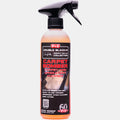
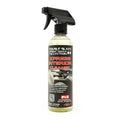
P&S Carpet Bomber is built exactly that way: citrus derivatives, biodegradable cleaning agents and water-based solvents that penetrate the fibre and dissolve the grease holding the soil in place. It rinses clean and carries the soil out with it. It's a concentrate, so it runs at full strength on the bad areas and diluted for general work.
It's also rated well beyond carpet — upholstery, mats, vinyl, and even engines and wheel wells — which is why it tends to be the bottle that gets picked up most often.

Cleaner + degreaser
P & S Carpet Bomber .473L — $11.99
Citrus-based carpet and upholstery cleaner that dissolves the grease holding soil in the fibre. Full strength on the worst areas, diluted for general work.
Shop Now
Gallon
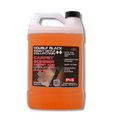
P & S Carpet Bomber 3.79L — $27.99
The gallon of Carpet Bomber. Since it's a concentrate you dilute to suit the job, this is the size that makes sense once it's in regular use.
Shop NowThe method, step by step
When the smell outlasts the stain
Organic spills — milk, pet accidents, anything protein-based — leave two problems, and cleaning only solves one. The mark comes out and the smell stays, because the odour source soaked past the surface into the padding.
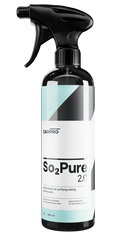
Air freshener does nothing here; it adds a scent on top of a smell that still has a source. What you need is something that destroys the odour molecules rather than covering them. CarPro SO2Pure works photocatalytically — treated surfaces keep breaking odour molecules down for months after application, rather than masking them.

For what's left behind
CARPRO SO2Pure 2.0 Odor Eliminator 500ml (17oz) — $29.99
Photocatalytic odour eliminator that destroys odour molecules instead of masking them, and keeps working for months. Smoke, pet, food and mildew.
Shop NowFor the rest of the interior
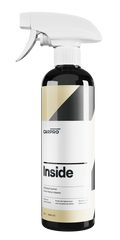
If you're already in there, a concentrate that covers every surface saves carrying four bottles. CarPro Inside dilutes to suit the material — full strength for heavy soiling, 1:1 for typical cleaning, 1:10 for delicate surfaces like Alcantara — and it's rated for leather, vinyl, plastic, fabric and carpet alike.

One bottle, every surface
CARPRO Inside (Cleaner/Concentrate) 500ml (17oz) — $19.99
Concentrated interior cleaner you dilute to the job: neat for heavy soil, 1:1 typical, 1:10 for Alcantara. Leather, vinyl, plastic, fabric and carpet.
Shop NowWhat doesn't work
The bottom line
Vacuum first, treat the stain rather than the floor, agitate properly, and pull the moisture back out before you leave. A cleaner-degreaser handles the majority of what actually lands in a footwell, and repeated light passes beat one aggressive attempt in almost every case.
And when the mark's gone but the car still smells, stop cleaning — that's a different problem with a different product.
Frequently Asked Questions
Can I use household carpet cleaner in a car?
It's a bad idea. Household products are formulated for carpet that sits over a pad and can dry through, while car carpet is bonded to closed-cell foam against a steel floor. The excess water has nowhere to go, and the residue those products leave behind attracts soil faster than the original stain.
Do I need an extractor to clean car carpet?
No, but it's the single biggest upgrade available. Without one, use less liquid and blot with real pressure into folded dry microfiber, refolding to a dry section each time. The principle is the same either way — get back out what you put in.
What dilution should I use for Carpet Bomber?
P&S doesn't publish a fixed ratio. They describe it as usable at full strength for the toughest jobs or diluted with water for lighter duty, so it flexes with how dirty the area is. Start weaker than you think, and step up only if a repeat pass isn't getting there.
How do I get an old set-in stain out?
Repeated light passes with proper agitation, not one aggressive attempt. Old stains usually need three or four cycles of apply, agitate, extract. If it stops improving between passes, you've likely reached the limit — some marks are dye in the fibre rather than soil on it.
Why does my car smell worse after I cleaned the carpet?
Almost always too much water. It soaked into the foam backing, which can't drain or air-dry, and it's now growing mildew. Dry the car out aggressively with airflow and sun, and treat the remaining odour with a product that destroys odour molecules rather than masking them.
Should I clean carpets before or after the dashboard?
Carpets first. Agitating and extracting fabric throws moisture and soil onto surrounding plastics, so doing hard surfaces first means doing them twice. Glass always goes last.
Related Reading
Get the Interior Back
Carpet cleaners, extractable degreasers and odour eliminators — shipped from our Orlando shop, or come see us in Kissimmee.
Shop Now →