Acid vs. Acid-Free Wheel Cleaners: Why It Matters.


Walk into any auto supply shop and you'll see a wall of wheel cleaners. Some acid-based, some acid-free, most labels unclear about which is which. The differences aren't cosmetic — choosing the wrong type can etch your wheels permanently, strip protective coatings, or cause discoloration that no amount of polishing will reverse.
This guide breaks down the actual chemistry behind each type, tells you exactly which finishes they're safe on, and gives you a clear decision framework so you never have to guess again.
Why Choosing the Wrong Cleaner Can Ruin Your Wheels
Wheels are the most chemically abused surface on your vehicle. They're constantly bombarded by brake dust — a corrosive mixture of iron particles, carbon fibers, and adhesive compounds that bakes onto the finish at high temperatures every time you press the brake pedal. On top of that, road tar, salt, and mineral deposits layer over the brake dust, creating a bonded crust that resists ordinary soap and water.
The wheel cleaner market evolved to address this with two fundamentally different chemical approaches: acid-based formulas that dissolve contamination through aggressive chemical reaction, and acid-free formulas that lift contamination using surfactants and iron-reactive agents. Both work. But they work on different types of contamination, and they interact with wheel finishes in very different ways. Using the wrong one is where the damage happens.

What "Acid-Based" Really Means
Acid wheel cleaners — typically containing hydrofluoric, phosphoric, or hydrochloric acid — work by dissolving brake dust and oxidation through direct chemical reaction. They sit low on the pH scale (usually pH 1–3) and break molecular bonds aggressively. The result is fast, powerful cleaning that can strip months of neglect in a single application.
The downside is that this same aggressive chemistry doesn't distinguish between brake dust and your wheel's finish. Acid can etch clear-coated wheels, attack anodized surfaces, strip powder coating, and cause permanent discoloration on chrome if left on too long or applied to hot wheels. The margin for error is measured in seconds, not minutes.
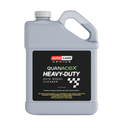
Quan AcidX is formulated for these heavy-duty situations: neglected wheels with months of baked-on buildup, raw aluminum that needs oxidation removed, and stained whitewalls that acid-free cleaners can't fully restore. It's a powerful tool — but it's a tool with specific use cases, not a daily driver.
The Case for Acid-Free
Acid-free wheel cleaners represent a fundamentally different approach. Instead of brute-force chemical dissolution, they use a combination of surfactants (to lift surface-level grime), detergents (to emulsify oil and tar), and iron-reactive agents (to dissolve ferrous brake dust particles) — all at a pH-balanced or near-neutral level that won't attack your wheel's protective finish.
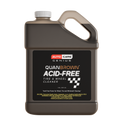
pH-balanced, color-changing formula. Turns purple as it reacts with iron brake dust — a visual indicator that contamination is being dissolved without attacking the wheel's finish. Safe on painted, powder-coated, chrome, alloy, and ceramic-coated wheels.
Shop Now →The purple color change you see with Quan Brown is the iron-reactive chemistry at work — the formula reacts specifically with ferrous (iron-based) brake dust particles, turning them purple/red as it dissolves them. No iron particles means no color change. This visual feedback tells you exactly where contamination is and when it's been dissolved, which is something acid cleaners can't do.
The trade-off is time. Acid-free cleaners generally need a longer dwell time (30–90 seconds) and may require light agitation with a wheel brush on heavier buildup. For weekly maintenance on wheels that haven't been neglected, this is barely noticeable. For wheels with months of baked-on contamination, an acid-free cleaner alone may not be enough — which is where the layered approach comes in.
Side-by-Side Comparison
| Factor | Acid-Based (AcidX) | Acid-Free (Brown) |
|---|---|---|
| pH Range | 1–3 (aggressive) | 6–8 (balanced) |
| Cleaning Power | Extreme — dissolves on contact | Strong — lifts & reacts with iron |
| Speed | 15–30 sec dwell | 30–90 sec dwell |
| Painted Wheels | Caution — test first | Safe ✓ |
| Powder-Coated | Caution — can strip | Safe ✓ |
| Chrome | Risky — can discolor | Safe ✓ |
| Ceramic-Coated | NEVER — degrades coating | Safe ✓ |
| Raw Aluminum | Effective ✓ | Limited — can't remove oxidation |
| Weekly Use | No — too aggressive | Yes — designed for it ✓ |
| Safety Risk | High — corrosive, PPE required | Low — skin/surface safe |
Ceramic-Coated Wheels: Special Rules
If your wheels have been professionally ceramic-coated — or if you've applied a DIY wheel coating — you need to know this: acid degrades ceramic coatings. Period. Even a single application of an acid wheel cleaner can compromise the hydrophobic layer that your coating provides, reducing its lifespan and defeating the purpose of the investment.
Stick exclusively with Quan Brown on coated wheels. The iron-reactive chemistry handles brake dust removal without touching the ceramic layer. In fact, coated wheels are easier to clean overall — contamination doesn't bond as aggressively to the hydrophobic surface, so a quick spray, dwell, and rinse is often all you need.
The Pro Move: Layered Cleaning
Professional detailers rarely use a single product on wheels. The approach that delivers maximum cleaning power with minimum risk is a layered sequence:
Step 1 — Acid-free first. Spray Quan Brown generously onto the entire wheel face. Let it dwell for 30–60 seconds. Agitate with a wheel brush, working into lug nut holes, behind spokes, and along the barrel. Rinse thoroughly. This safely removes 80–90% of contamination on most wheels.
Step 2 — Assess what's left. After rinsing, inspect for remaining deposits. If the wheel looks clean, you're done. If stubborn stains remain — usually dark spots around the lug area or in the inner barrel — that's when you bring in the acid.
Step 3 — Acid spot-treatment. Spray Quan AcidX only on the remaining trouble spots, not the entire wheel. Short dwell time (30–60 seconds maximum), immediate rinse. This gives you the cleaning power of acid where you need it, with minimal total exposure to the wheel's finish.
Iron Removers vs. Wheel Cleaners: What's the Difference?
This is a question we get constantly: "If Quan Brown reacts with iron, why do I also need Quan Purge?" The answer is about depth of contamination.
Wheel cleaners (like Quan Brown) are formulated to lift surface-level brake dust, road grime, and loosely bonded iron particles during a regular wash. They work on the stuff sitting on the surface. Iron removers (like Quan Purge) are dedicated decontamination agents formulated to dissolve iron particles that have embedded into the surface — particles that have penetrated the clear coat or pores of the wheel finish and bonded at a molecular level.
You use Quan Brown every week. You use Quan Purge 2–4 times per year as a decontamination step, or specifically before applying a wheel coating or sealant. They're complementary products, not substitutes.
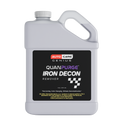
Dedicated iron and fallout remover for paint and wheels. Dissolves bonded iron particles that surface-level cleaners can't reach. Use before coating application or as a seasonal decontamination step.
Shop Now →When to Use What
| Scenario | Product | Why |
|---|---|---|
| Weekly maintenance | Quan Brown | Safe on all finishes, zero risk, iron-reactive |
| Heavy brake dust | Brown → AcidX (spot) | Layered approach, minimal acid exposure |
| Raw aluminum / whitewalls | Quan AcidX | Acid needed to dissolve oxidation |
| Ceramic-coated wheels | Quan Brown only | Acid degrades ceramic coatings — no exceptions |
| Monthly deep clean | Brown → AcidX as needed | Full layered sequence for thorough results |
| Pre-coating decon | Quan Purge | Dissolves bonded iron before sealant/coating |
Safety & Best Practices
For Acid Cleaners (Quan AcidX)
Always wear chemical-resistant gloves and eye protection. Apply only to cool, wet wheels — hot metal flash-dries the formula, concentrating the acid and dramatically increasing the risk of etching. Work one wheel at a time. Never allow the product to dry on the surface. Rinse thoroughly within 60 seconds of application. Test on an inconspicuous area first if you're unsure about your wheel's finish type.
For Acid-Free Cleaners (Quan Brown)
Acid-free describes what the product won't do to your wheel finish — it does not mean it is gentle on you. Quan Brown is strongly alkaline (pH 13–14, sodium hydroxide) and its safety data sheet classifies it as causing severe skin burns and eye damage, so wear chemical-resistant gloves and eye protection, work in a ventilated area, and avoid breathing the mist — the same precautions you would take with the acid product. Avoid spraying directly into wind. Don't apply to wheels in direct sunlight if they're extremely hot, since the product dries faster and becomes less effective. Rinse thoroughly after use. The purple residue from iron reaction washes off completely with water.
Universal Rules
Never mix wheel cleaners. Don't apply acid-free and acid-based products simultaneously — the chemical interactions are unpredictable. Always complete one product's cycle (apply, dwell, agitate, rinse) before applying another. Clean wheels after the body wash, not before, to avoid dirty wheel overspray on clean paint. Use dedicated wheel brushes that never touch body panels.
Wheel Care Shopping List
The complete wheel care lineup from the Quan Collection:

Clean Wheels, Zero Guesswork.
The right wheel cleaner for every situation — shipped free on orders over $75.
Shop Wheel Care Products →Frequently Asked Questions
Can acid wheel cleaner damage my wheels?
Why does Quan Brown turn purple?
What about Quan Purge — is that a wheel cleaner?
Can I use acid wheel cleaner on ceramic-coated wheels?
How often should I clean my wheels?
What's the difference between a wheel cleaner and an iron remover?
Ready to shop non-acid?
Browse our full non-acid wheel and tire cleaner lineup → — Quan Brown, Ezy Wheel, Ardex Proper, and Brighto compared.